
My Choice Texas Home, and the rule most people get wrong about it
My Choice Texas Home is the TDHCA program you can use even if you have owned a home before. It carries 2-5% down payment assistance, no purchase price cap, and a trade-off nobody mentions: the interest rate is set by the state, not by the market.
What is My Choice Texas Home?
My Choice Texas Home is a down payment assistance program run by the Texas Department of Housing and Community Affairs, and its defining feature is who it lets in: you do not have to be a first-time buyer. It pairs a 30-year fixed first mortgage with a second lien worth 2% to 5% of the total loan amount, usable for the down payment, the closing costs, or both.
Deferred repayable or forgivable: the two assistance options
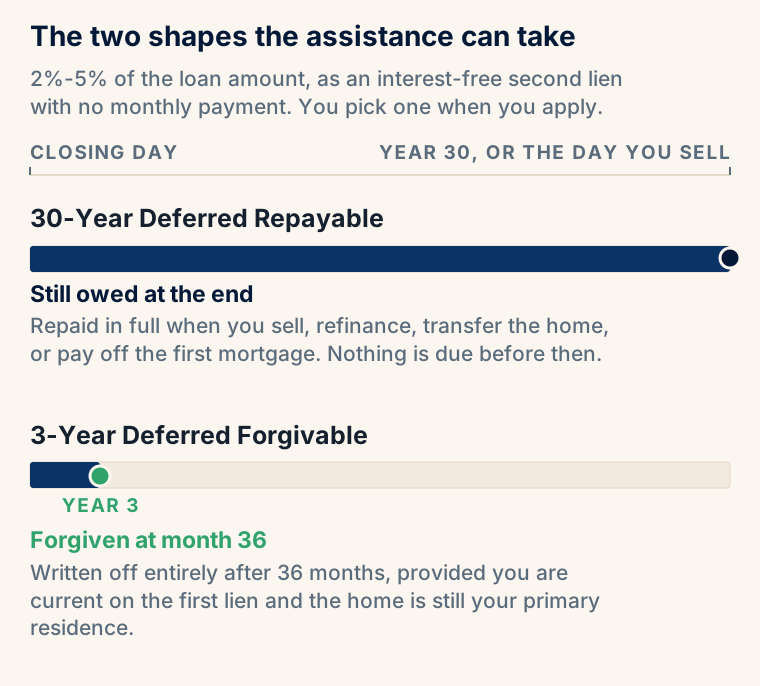
The help arrives as a second lien rather than a check, and you choose which shape it takes when you apply. Both are interest-free.
- 30-Year Deferred Repayable: 0% interest, no monthly payment, repaid in full when you sell, refinance, transfer or pay off the first mortgage.
- 3-Year Deferred Forgivable: forgiven entirely after 36 months, provided you are current on the first lien and the home is still your primary residence.
Who is eligible to qualify for the My Choice Texas Home program?
You need a middle credit score of at least 620, household income within TDHCA's published limit for your county and household size, a completed homebuyer education course for every borrower, and the home must be your primary residence. There is no first-time buyer requirement and no purchase price cap.
Who administers it, and how you apply
TDHCA runs the program through The Texas Homebuyer Program, and you apply through a participating lender rather than to the state directly. The state sets the terms; an approved lender originates the loan. You cannot apply to the agency yourself.
My Choice vs My First Texas Home: which one applies to you?
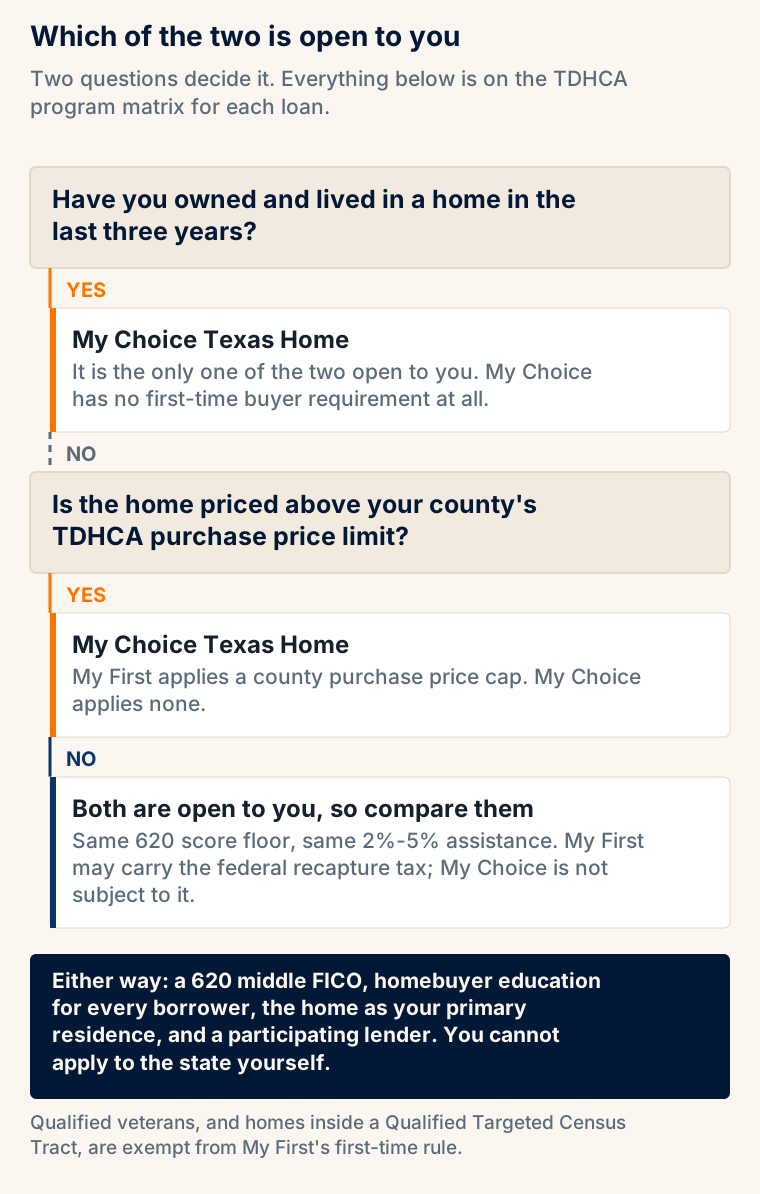
These two come from the same agency and look almost identical on paper, which is why they get confused constantly. The differences are few in number and large in consequence: one is open to repeat buyers and has no price cap, the other is not and does.
How does the My First Texas Home program work?
It works the same way mechanically, with the same 2-5% second lien and the same 620 score floor, but it is aimed at first-time buyers and applies county-specific purchase price caps. Qualified veterans and buyers in a Qualified Targeted Census Tract are exempt from the first-time requirement, which is the exemption most people never hear about.
Which one should you be asking about?
If you have owned a home before, My Choice is usually the only one of the two available to you. If you are buying above your county's price cap, the same is true even if you are a first-time buyer. If neither applies, compare both, because My First reaches conventional borrowers differently.
Do you have to be a first-time buyer at all?
Not for My Choice. The program matrix states it plainly: no first-time homebuyer requirement, open to first-time buyers, repeat buyers and qualified veterans alike. This is the single most useful thing to know about it.
What counts as a first-time buyer in Texas anyway
Most Texas assistance programs use the federal definition, which is broader than the name suggests: you generally qualify if you have not owned and occupied a principal residence in the previous three years. People who owned a home before a divorce, or who have been renting since selling, are frequently eligible again without realizing it.
| My Choice Texas Home | My First Texas Home | |
|---|---|---|
| First-time buyer required? | No. Open to first-time buyers, repeat buyers and qualified veterans | Yes, with exemptions for qualified veterans and homes in a Qualified Targeted Census Tract |
| Purchase price limit | None | Yes, county-specific, per TDHCA's published table |
| Down payment assistance | 2%-5% of the total loan amount | 2%-5% of the total loan amount |
| Minimum credit score | 620 middle FICO | 620 middle FICO |
| Loan types | FHA, VA, USDA and Conventional | FHA, VA, USDA |
| Income limits | Yes, per TDHCA's published table | Yes, per TDHCA's published table |
| Homebuyer education | Required for all borrowers | Required, HUD-certified course |
| Federal recapture tax | Not subject to it | May apply |
Is the assistance actually worth it? Rates and the real trade-off
This is where the program deserves an honest answer rather than a brochure one. Down payment assistance is not free money in the way it is usually described, and the cost is not in the second lien. It is in the interest rate on the first.
The rate is set by the state, not by the market
On TDHCA and TSAHC loans the interest rate is not quoted by your lender against the market that day. It is set centrally by the agency and republished on its own schedule, and the cost of the assistance is built into that rate rather than charged separately. So the comparison that matters is not the second lien against zero, it is the agency's rate sheet on the day you lock against what you are quoted without assistance.
The two-quote test that settles it
The arithmetic is not complicated and almost nobody does it. Ask your lender for two quotes, side by side, for the same house on the same day.
- Quote A: My Choice Texas Home, with the assistance amount and the program's interest rate.
- Quote B: a market-rate loan with no assistance, using whatever down payment you can actually cover.
- Compare the total you pay over the years you realistically expect to stay, not over thirty.
- If you expect to move or refinance within five years, the assistance usually wins. If you expect to stay put, the rate usually does.
The trade-off is real, not a reason to skip it
For a buyer who genuinely cannot cover the down payment, a slightly higher rate on a home you own beats a lower rate on a home you never bought. The point is to make the comparison deliberately rather than being handed one option and told it is help.
What are the income limits and credit requirements?
The program's requirements are short, and none of them is the hurdle people expect. Income limits apply and vary by county and household size, so the only honest answer to whether you qualify is one that looks at your county.
- A middle credit score of at least 620.
- Household income within TDHCA's published limit for your county and household size.
- A completed homebuyer education course, required for every borrower on the loan.
- The home must be your primary residence.
- A participating lender. You cannot apply to the state directly.
What is the income limit for down payment assistance in Texas?
There is no single statewide number. TDHCA publishes a table of limits by county and household size, and the ceilings in the higher-cost metros are materially higher than most people assume. Because the limit moves with both your county and how many people are in your household, checking the current table for your county is the only way to get a real answer.
What is the lowest credit score to buy a house in Texas?
For this program the floor is a 620 middle FICO. Other routes go lower, and some county programs accept 580, but a lower score generally means a different program rather than no program. The score a mortgage lender pulls is also not the score most consumer apps show you, which is why people are frequently more qualified than they believe.
There is no purchase price cap on this one
My First Texas Home applies county-specific purchase price limits. My Choice Texas Home does not, which is what makes it usable in the parts of Texas where prices have moved fastest and where the other program quietly stops working.
The homebuyer education requirement catches people late
Every borrower on the loan has to complete an approved course before closing, and it trips people up more often than the credit or income rules because it is usually discovered last. Most people finish one online in a single sitting. Do it before you are under contract, not in the week when everything else is also happening.
Which local down payment assistance programs stack on top?
The statewide assistance is often the smaller half of what a buyer ends up using. Texas cities and counties run their own programs with their own budgets, and several are considerably larger than the 2-5% the state provides. My Choice is not subject to the federal recapture tax, which removes one common reason buyers are told not to stack.
The second statewide agency most people miss
TDHCA is not the only state-level option. The Texas State Affordable Housing Corporation runs its own programs on a parallel track, including Homes for Texas Heroes for teachers, teacher aides, librarians, counselors, first responders, corrections officers and veterans, and Home Sweet Texas Home for everyone else. Both carry a 620 minimum credit score.
Why the ceilings above are not what you will receive
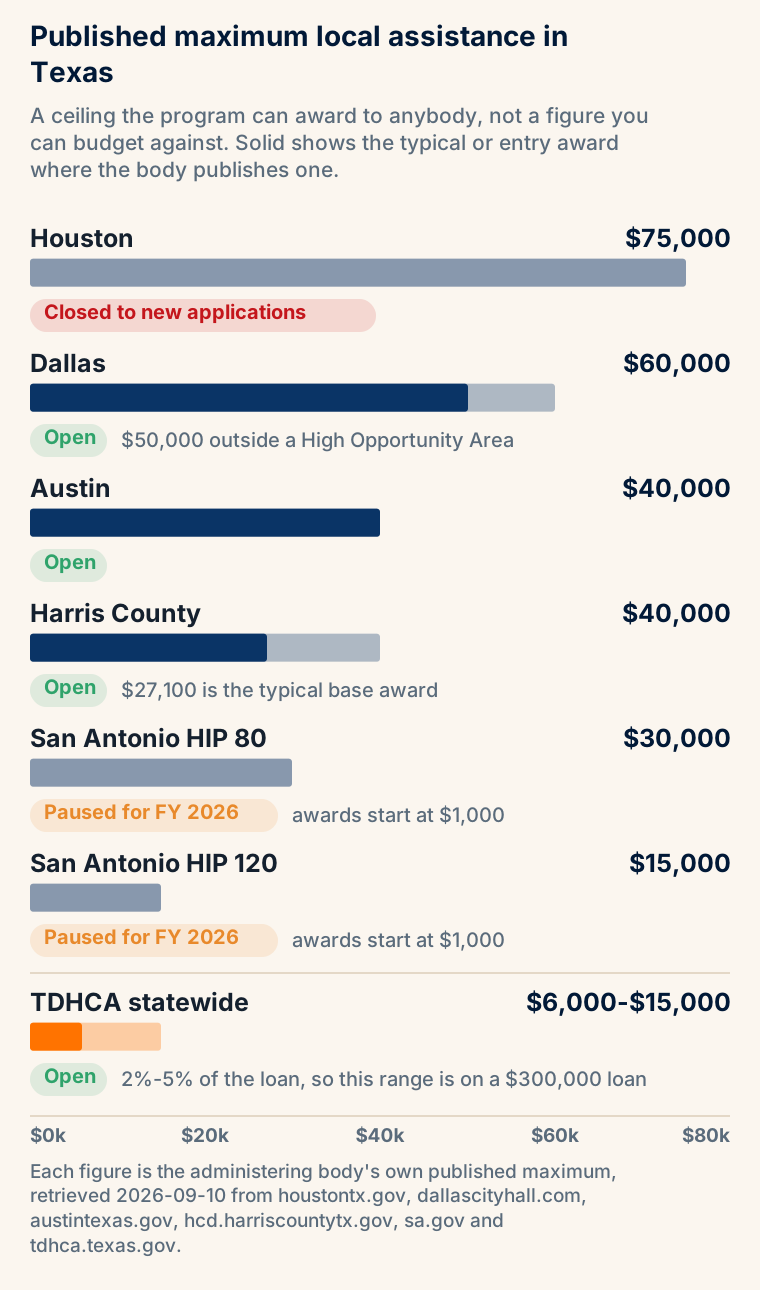
A published maximum is the largest award the program can make to anybody, and most awards are materially smaller. The amount is calculated from household income, the purchase price, the census tract and how much money the program has left in its current cycle. Treat the column above as a reason to ask, not a number to budget against.
| Program | Administered by | Published maximum | Status when checked | Who it targets |
|---|---|---|---|---|
| Homebuyer Assistance Program (HAP) | City of Houston Housing and Community Development | Up to $75,000 | Closed to new applications, funds exhausted | Subsidy scaled to household financial need |
| Dallas Homebuyer Assistance Program (DHAP) | City of Dallas Housing and Homelessness Solutions | $60,000 in High Opportunity Areas, $50,000 elsewhere | Open, administered by BCL of Texas | Extra funding for targeted neighborhoods |
| City of Austin Down Payment Assistance | City of Austin Housing Department | Up to $40,000 | Open | General |
| Harris County Down Payment Assistance | Harris County Community Services Department | Up to $40,000, typical base award $27,100 | Open | Low-to-moderate income in qualified census tracts |
| Homeownership Incentive Program 80 (HIP 80) | City of San Antonio Neighborhood and Housing Services | $1,000-$30,000 | Not accepting applications for FY 2026 | Households up to 80% of area median income |
| Homeownership Incentive Program 120 (HIP 120) | City of San Antonio Neighborhood and Housing Services | $1,000-$15,000 | Not accepting applications for FY 2026 | Moderate income, up to 120% of area median income |
How much house can you actually afford in Texas?
This is the question underneath the program question, and it is the one people search most. Assistance changes what you need on day one. It does not change what the house costs every month, and in Texas the monthly number is driven by something most buyers underestimate.
Why the Texas monthly payment is not just principal and interest
Texas has no state income tax and makes up the shortfall largely through property tax, which is levied by counties, cities and school districts and escrowed into your monthly payment alongside insurance. Two homes at the same price in different districts can carry noticeably different monthly costs, which is why a price you can afford in one county may not work in the next.
What decides the number for you specifically
Four things move it more than the headline price: the tax rate of the district the house sits in, the insurance premium for that property, your other monthly debt, and whether the seller pays your closing costs. A payment estimate that ignores the first two is not an estimate of a Texas mortgage.
Where down payment assistance actually helps
It removes the day-one barrier, which for most first-time buyers is the real one. It does not lower the monthly cost, and a program that gets you into a house whose monthly payment you cannot carry has not helped you. Work the monthly number first, then find the program that closes the day-one gap.
What most people get wrong, and how to check your own situation
Three assumptions send people away from this program before they ever ask a question, and all three are wrong often enough to be worth checking rather than believing.
- "I owned a home before, so assistance is not for me." My Choice Texas Home has no first-time buyer requirement at all.
- "I earn too much." Income limits are set per county and household size, and in the higher-cost metros they are higher than most people assume.
- "I already asked and there was nothing." Texas runs dozens of programs across state, county and city level. One lender's answer is one lender's list.
The four variables that decide your answer
Whether My Choice Texas Home fits depends on your county, your household size, your credit and how long you expect to stay in the house. That is four variables, which is exactly why a general article cannot finish the job and a two-minute questionnaire can.
Want this checked against your own situation?
The free class covers the whole picture in 45 minutes. Or take two minutes and see which programs are worth a look for someone in your position.