
Property taxes in Texas, and why they decide more than the down payment
Texas has no state income tax and a property tax bill that surprises most first-time buyers. The reason is not the trade-off people assume, and the difference between two identical houses a mile apart can be larger than the difference between two mortgage rates.
Why are property taxes so high in Texas?
Because property tax in Texas is a purely local tax, and the largest line on the bill belongs to the one government that has almost nothing else to collect. Texas has no state property tax at all. Every dollar is set and collected locally.
The trade-off is real, but it is not the one people describe
The usual explanation is that Texas swaps an income tax for a property tax. Half of that is right. An individual income tax is not merely absent, it is constitutionally prohibited: since November 2019 the Texas Constitution has said the legislature may not impose a tax on the net incomes of individuals. But the Comptroller is explicit that the state's substitute is primarily sales tax, not property tax. The property tax story is a local one, and the Comptroller states the mechanism plainly: some taxing units have access to other revenue sources, such as a local sales tax, while school districts must rely on local property tax and state and federal funds. That is why the school district line dominates almost every Texas tax bill. It is the one taxing unit with no sales tax to fall back on.
- Texas Constitution, Article VIII, Section 24-a (individual income tax prohibited): tcss.legis.texas.gov
- Texas Comptroller, Texas Property Tax Basics, January 2026: comptroller.texas.gov
Which governments actually tax your house
More than 4,796 local taxing units in Texas assess property tax. Counties and school districts tax all non-exempt property within their jurisdiction. Cities and special purpose districts, such as hospitals, junior colleges or water districts, may also collect. Two separate bodies are involved in what you pay and they do different jobs: the appraisal district values the property as of January 1, and the governing body of each taxing unit sets its own rate. As the state's own consumer page puts it, the Texas Legislature does not set the amount of your local taxes, and neither does your appraisal district.
Is it true that Texas has the highest property taxes in the country?
That claim needs its date and its other half. The Comptroller, citing Tax Foundation figures, reports that Texas ranked sixth highest among all states in 2020 for effective property tax rate, at 1.66% of home value. That is 2020 data from a think tank, quoted by a state agency, not a current state measurement. The same Comptroller article records that in 2022 Texas ranked sixth lowest for total effective state and local tax burden, partly because there is no personal income tax. Both halves are true and a buyer deciding where to live deserves both. High property tax, low total burden.
| Line on the bill | Who sets it | 2025 DFW range, per $100 of value | How much it moves the bill |
|---|---|---|---|
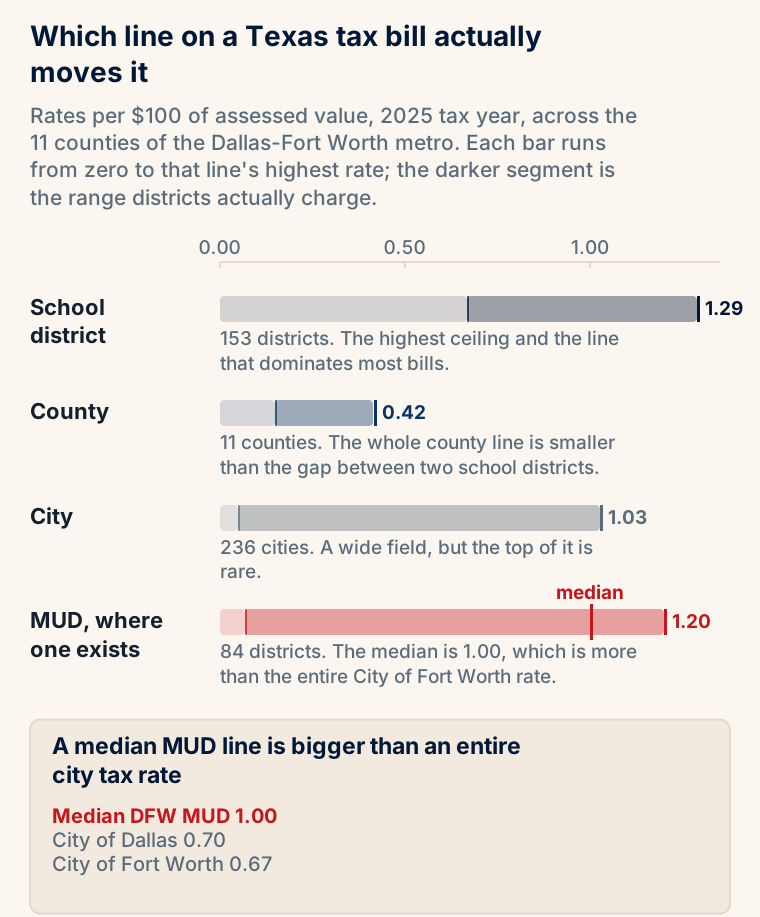
| School district | the ISD board | 0.6669 to 1.2869 (153 districts) | The largest line, and the widest spread. This is the one that moves it. |
| County | commissioners court | 0.1493 to 0.4151 (11 counties) | Small. A whole county apart is worth less than a quarter of a point. |
| City | city council | 0.0487 to 1.0261 (236 cities) | Wide in range but usually well under the school line. |
| MUD, where one exists | the district's elected board | median 1.00, up to 1.20 (84 districts) | Adds a line most buyers do not know to look for. See below. |
| PID, where one exists | the city or county | not a rate; an apportioned assessment | Cannot be quoted as a rate. It is billed as installments. |
How much is a monthly mortgage payment for a $250,000 dollar home in Texas?
There is no single Texas answer, and the tax rate of the district is the reason why. Principal and interest are only part of it. In almost every Texas mortgage the tax bill and the insurance premium are collected monthly alongside the loan payment and held in escrow, so two identical houses with identical loans can carry noticeably different monthly costs purely on where they sit.
What escrow is, and the limit on what a servicer may hold
An escrow account is an account your servicer controls to pay taxes, insurance and other property charges, funded from a portion of your monthly payment. It is not optional goodwill; it is defined and governed by federal rule. A servicer may hold a cushion, and that cushion is capped: no greater than one sixth of the estimated total annual payments from the account, which is two months. Because taxes and premiums change from year to year, the escrow portion changes with them, and so does the total monthly payment.
- 12 CFR 1024.17, escrow accounts (Regulation X): consumerfinance.gov
- CFPB, what is an escrow or impound account: consumerfinance.gov
Why the tax line decides what you qualify for, by rule
This is the part that is usually left out, and it is federal regulation rather than opinion. Under the ability-to-repay rule a creditor must consider the consumer's monthly payment for mortgage-related obligations, and the rule defines mortgage-related obligations as property taxes first, then insurance premiums, association fees and assessments, ground rent and leasehold payments. Your debt-to-income ratio is all your monthly debt payments divided by your gross monthly income, and the tax line sits inside it by definition. So a higher tax rate does not simply make the same house more expensive. It reduces the loan amount the same income supports.
- 12 CFR 1026.43(b)(8) and (c)(2)(v), ability to repay: consumerfinance.gov
- CFPB, what is a debt-to-income ratio: consumerfinance.gov
Does down payment assistance help with property taxes?
No, and this is the most common misunderstanding about these programs. Assistance changes what you need on day one. It does not change what the house costs every month, because the tax rate of the district is unaffected by how you funded the down payment. Worth knowing before anyone builds a plan around it: a program can make a house reachable at closing and still leave it unaffordable at the twelfth payment.
Why do two identical houses a mile apart have different tax bills?
Usually because one of them sits inside a special district and the other does not. Two of these matter to a first-time buyer in North Texas, they work differently, and almost every listing blurs them.
A MUD is a tax. A PID is an assessment.
A municipal utility district provides water, wastewater, drainage and similar services inside its boundaries, and it typically funds the infrastructure with bonds. Voters authorise the bonds and, with them, a debt-service tax to pay the bonds off. In the state regulator's own words, that tax is levied on all property in the district based on appraised value, regardless of the services received by each landowner. It appears as a rate on your tax bill. A public improvement district is different in kind: the city or county apportions the cost of improvements across the properties that benefit, and it may do so equally per front foot, per square foot, by value, or in any other manner producing equal shares among similarly benefited property. That is why a PID cannot honestly be quoted as a rate, and why two houses in one PID can owe different amounts for reasons unrelated to appraised value. A PID assessment is also a first and prior lien on the property, outranked only by state, county, school district and municipal ad valorem taxes.
- TCEQ, Texas Water Districts: A General Guide (GI-043): tceq.texas.gov
- Texas Local Government Code Chapter 372, Public Improvement District Assessment Act: tcss.legis.texas.gov
The two notices you are entitled to before you sign
Both are pre-contract by statute, and knowing that is the whole defence. A seller must give the MUD notice to a prospective purchaser before execution of a binding contract of sale; if that does not happen, the purchaser is entitled to terminate. The catch is written into the same subsection: if the seller furnishes the notice at or before closing and the buyer elects to close anyway, it is conclusively presumed that the buyer has waived all rights to terminate. The PID notice works the same way. Texas Property Code Section 5.014 prescribes the words, including that the assessment may be paid in full at any time, that unpaid installments vary from year to year, and that failure to pay may result in a lien and foreclosure, and it requires the purchaser's signature before the effective date of a binding contract. Ask for both notices when you first see a house, not when you are handed a stack at the title company.
- Texas Water Code Sec. 49.452(f), notice to purchasers: tcss.legis.texas.gov
- Texas Property Code Sec. 5.014, notice of obligations related to public improvement district: tcss.legis.texas.gov
What Brad sees on the ground
Brad Pounds has spent years walking buyers through these communities in DFW, and his account is worth reading beside the statute. On the spread: “you can be on this side of the highway and pay two point zero percent taxes and be on this side of the highway, same floor plan, same builder and pay two point seven percent taxes. There are taxes in DFW as high as three point one.” On the disclosure: “They'll put the the base tax rate, and then they don't even mention the pit. They don't even mention the mud until you get out there.” And on what it costs when nobody catches it: “It was too late to help them. And they said they never even heard about the PID until it was time to go to close.” The published 2025 data supports the shape of what he describes rather than the exact figures: across the DFW metro the school district rate alone runs from 0.6669 to 1.2869, and a median MUD adds another 1.00 per $100 on top. That single MUD line is larger than the entire city tax rate of Fort Worth or Dallas.
What does the homestead exemption actually save you?
It removes a slice of your home's value from taxation before the rate is applied, and for the 2026 tax year the school district slice is large. An adult is entitled to an exemption from school district taxation of $140,000 of the appraised value of their residence homestead, raised from $100,000 by Senate Bill 4 of the 89th Legislature and in force for tax years beginning on or after January 1, 2025. Owners who are 65 or older or disabled are entitled to an additional $60,000 from the school district. Say it as two numbers, because the statute is two subsections and the form will show you two.
The arithmetic, and the year-two surprise nobody warns you about
The Comptroller does the maths itself: if a home is valued at $300,000 and the owner qualifies for a $140,000 residence homestead exemption, they pay taxes as if the home were worth $160,000. Any taxing unit may also offer a local option exemption of up to 20 percent of value, with a $5,000 floor, but that one is per taxing unit and is not uniform across the metro, so check the specific jurisdiction rather than assuming. Then the part that catches first-time buyers: the 10 percent annual cap on how much a homestead's appraised value can rise takes effect on January 1 of the tax year following the first year you qualify. You do not have the cap in year one. A first year with no cap, an escrow account that adjusts when the tax bill moves, and a payment that rises in year two is not a mistake by your servicer. It is the system working as written.
- Texas Tax Code Sec. 11.13, residence homestead: tcss.legis.texas.gov
- Texas Tax Code Sec. 23.23, limitation on appraised value: tcss.legis.texas.gov
Filing it, and what happens if you miss the deadline
The general deadline to file an exemption application is before May 1, and once a homestead exemption is allowed it need not be claimed again in later years until the property changes ownership or the owner's qualification changes. It is one form, once. Missing the deadline is not fatal either: the Tax Code provides for late application for a residence homestead exemption, and a chief appraiser must accept and act on one filed up to two years after the delinquency date for the taxes on the homestead. File on time, and if you did not, file anyway.
- Texas Tax Code Sec. 11.43 and Sec. 11.431, application and late application: tcss.legis.texas.gov
- Texas Comptroller, property tax exemptions: comptroller.texas.gov
How do you find the real tax rate for a specific address?
There are two statutory routes and one directory, and none of them require a third-party estimator. Use them before you write an offer, not after.
- The county property tax database. Every chief appraiser must create and maintain a public database that is searchable by property address and owner, and it must list the name of each taxing unit in which the property is located, along with each unit's proposed rate and the taxes that would be imposed. That last part is the answer to the MUD question: it shows you every taxing unit on the parcel, not just the ones on the listing. The state's front door for it is Texas.gov Property Tax Transparency, which routes you to your county's Truth in Taxation site: texas.gov
- The appraisal district itself. The Comptroller publishes a statewide directory of every county appraisal district and tax assessor-collector, including the taxing units each one serves: comptroller.texas.gov
- The MUD's own Notice to Purchaser. Where a district exists, the prescribed notice must state the current district property tax rate per $100 of assessed valuation, the total bonds approved by voters, and the amounts issued. Ask the seller's agent for it in writing.
Want this checked against your own situation?
The free class covers the whole picture in 45 minutes. Or take two minutes and see which programs are worth a look for someone in your position.