
Down payment assistance in Texas
Assistance in Texas arrives in five different shapes, and the shape decides what you owe in year four. Five different kinds of organisation administer it, none of them takes an application from you directly, and an open programme is not the same thing as a funded one.
What down payment assistance actually is in Texas
Down payment assistance is money from a third party that covers part of your down payment and closing costs at the table. It is not a discount on the house and it is not a reduction in what you borrow for the house itself. Brad is deliberate about this boundary because he has watched people misunderstand it: “I want to be slow, loud and clear about this is that they're built to help you buy a home, not buy it for you.” He has the misread on record too, from a webinar attendee: “I had a young man in the webinar one time who was very energetic, and he said, I'm going to stack me a bunch of grants and get me a free house.” That is not what any of these programmes do.
Where the money comes from, and why that matters to you
Assistance is somebody else's money arriving at your closing, and whose money it is determines the rules attached to it. On the state's first-time product the assistance is sized as a share of the loan rather than a flat cheque, in the range of 2% to 5% of the total loan amount, and it is explicitly subject to funding being available. That last clause is doing real work and most articles drop it.
- The Texas Homebuyer Program, My First Texas Home programme matrix: welcomehome.tdhca.texas.gov
The five shapes assistance takes, and what each one costs later
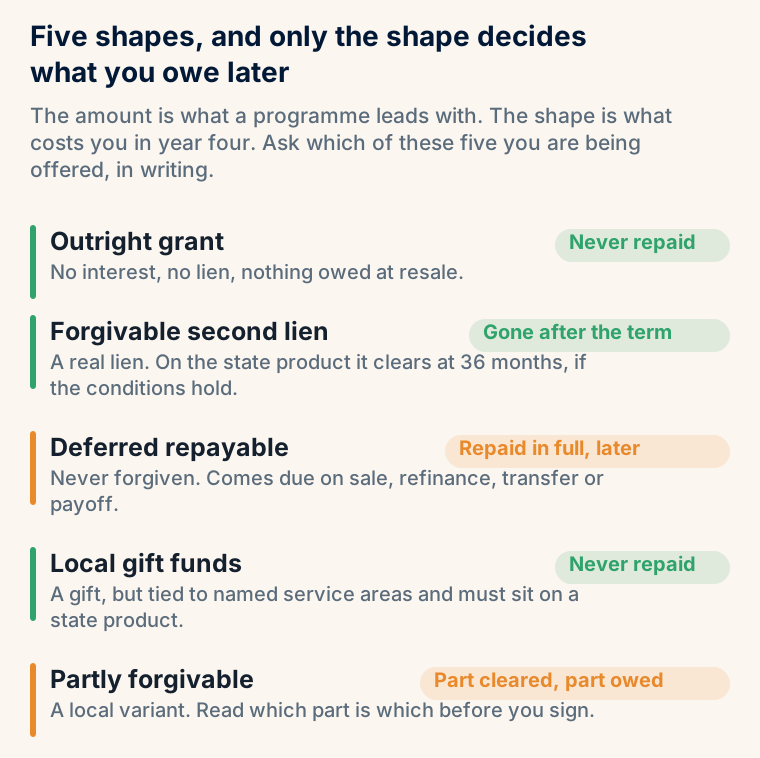
This is the only thing on this page that changes what you owe in year four, and it is the question to ask before you accept anything. Brad states the taxonomy the way a lender meets it: “Some of these payment structures are basically second liens. Some of them are forgivable second loans and some of them are just outright grants. They cut you a check and that's all she wrote.” In practice across Texas there are five, not three, and two of them only appear locally.
Why the shape matters more than the amount
A larger deferred lien can cost you more at resale than a smaller grant saves you at closing, and the two are frequently presented side by side as though they were the same product in different sizes. The number a programme leads with is the amount. The number that decides what this costs you is the shape. Ask which of the five you are being offered, in writing, before you sign anything.
| Shape | What happens to the balance | The question to ask |
|---|---|---|
| Outright grant | Never repaid, in any circumstance, and it does not accrue interest. | Is this genuinely a grant, or a forgivable loan being described as one? |
| Forgivable second lien | A real lien that disappears after a set period, on conditions. On the state product that period is 36 months, and it requires staying current on the first lien and keeping the home as your principal residence. The state publishes this lien as carrying no interest and no monthly payment. | What is the period, and what are the conditions that have to hold throughout it? |
| Deferred repayable second lien | Never forgiven. It sleeps until you sell, refinance, transfer, or pay off the first mortgage, then it comes due. The state publishes it as carrying no interest and no monthly payment, so the balance does not grow while it sleeps. | Is any of this forgiven, or is all of it deferred? |
| Local gift funds | An outright gift from a local housing finance corporation, with no repayment. It must be layered on a state product rather than taken alone, and it is tied to named service areas. | Does my address sit inside the service area? |
| Partly forgivable | A local variant where part of the balance is forgiven on a schedule and part never is. | Which part is forgiven, and what is the schedule? |
Who actually administers assistance in Texas
The word programme hides five different kinds of organisation, and they are funded differently, governed differently, and run out of money at different times. This is the distinction almost nobody draws, and it explains most of the confusing advice on this subject.
The state agency and the state nonprofit
One administrator is the Texas Department of Housing and Community Affairs, a state agency. The other is not a government department at all: it is a nonprofit corporation created at the direction of the Texas Legislature, with its own board and its own products. Brad's practitioner shorthand is that they are “kind of like twins,” which is fair when you are comparing assistance amounts and stops being fair the moment something goes wrong on your file, because one is an agency and the other is a corporation and they answer to different people.
Cities, counties and housing finance corporations
Local assistance comes from two different local bodies that are easy to confuse. A city or county housing department runs one kind, funded largely by federal block grants passed down to it. A housing finance corporation is a separate public corporation operating under Chapter 394 of the Texas Local Government Code, and it is the source of the gift funds that layer on state products. Brad explains the family resemblance better than any agency page does: “The reason that it's very similar is because all of these start with monies from federal block grants. So the feds kind of say, hey, here are the broad strokes that you have to operate this program within.” That is why Dallas, Houston and San Antonio programmes rhyme without being copies.
And a Federal Home Loan Bank, which you cannot approach
The fifth channel is a Federal Home Loan Bank. It never pays a buyer directly and moves money only through its member financial institutions, so there is no version of this where you apply. It also supplies the clearest live example of the point this page keeps making about funding: as of this writing its 2026 homebuyer allocation shows zero dollars available. The programme is open. The money is gone. Those are different things, and the allocation runs until it is spent or the calendar year ends, whichever comes first.
How a Texas buyer actually reaches assistance
You do not apply to any of them. Every route runs through a lender, and this holds across all five administrators rather than being one programme's quirk. The state nonprofit routes buyers to a participating lender and the lender files the paperwork. The state agency restricts its assistance to approved mortgage companies. City programmes run through the buyer's own lender, which is why a city programme is a layer on a mortgage rather than a separate transaction. Brad describes the mechanism from the lender's side: “The lender submits it on your behalf. They really just put it into a computer and then it pops up that you're TDHCA eligible.”
What it adds to your timeline
Less than most buyers fear, and Brad has the number nobody else publishes: “It typically adds about 48 hours to the underwriting process, sometimes less like literally,” and “there's not a lot of extra paperwork here.” The thing that genuinely does take time is the condition every state route attaches, which is a homebuyer education course. It is a requirement of the assistance rather than an optional extra, and it is the step people discover last and regret most. Do it before you are under contract.
An open programme is not a funded programme
City assistance stops taking applications when its money is spent, and it does so mid-year without ceremony. One large Texas city's programme is closed for the current fiscal year and reopens only if the council renews the funding. This is the single most useful thing to check before you build a plan around any particular programme, and it is the thing programme pages are slowest to update. Ask your loan officer whether the specific programme has funds available this week, not whether it exists.
Who qualifies, and the rules people get wrong
Two assumptions cost Texas buyers more than any other. The first is that assistance is only for first-time buyers. It is not: the state runs a parallel product with no first-time requirement at all, open to repeat buyers and qualified veterans. The second is that first-time means never having owned. It does not. The test is a three-year ownership-and-occupancy test, so someone who owned a home before a divorce, or sold and has been renting since, is frequently back inside the definition without realising it. Even on the first-time product there are written exceptions for targeted areas and for qualified veterans.
Not every form of help is cash at closing
A mortgage credit certificate is a different instrument entirely: a federal tax credit rather than money toward your down payment. It can sit alongside assistance or stand on its own, and it does something for you only if you owe federal income tax. It gets grouped with down payment assistance constantly, and it is worth separating in your own head before you compare offers, because the two are not alternatives to each other.
The same buyer gets different answers in neighbouring counties
Local gift funds are tied to named service areas, so an identical file can qualify at one address and not at another a few miles away. This is the part that makes general advice about Texas assistance nearly useless, and it is why the question is always which programmes are open to this address, in this county, with funds available now. It is a property question before it is a person question.
Want this checked against your own situation?
The free class covers the whole picture in 45 minutes. Or take two minutes and see which programs are worth a look for someone in your position.