
Zero interest, no monthly payment: how a deferred forgivable second works
A deferred forgivable second can carry zero interest and no monthly payment. How forgiveness works, and the one condition that makes it repayable in full.
Does down payment assistance add a second monthly payment?
A common question from buyers comparing real options: if they take down payment assistance, does that just add a second payment on top of the mortgage? Not necessarily.
One structure, the deferred forgivable second lien, has zero interest and no monthly payment, and with some programs it is forgiven after three years. It also comes with one condition that every buyer should understand before accepting it.
How does a deferred forgivable second work?
It is a loan for the amount of the down payment, plus some extra room for closing costs, usually 2% to 5% of the loan amount. What makes it different from what most people picture when they hear "loan": it is recorded as a second lien on the property, there is no monthly payment on it, and it charges zero interest.
It sits behind the first mortgage without adding to the monthly budget.
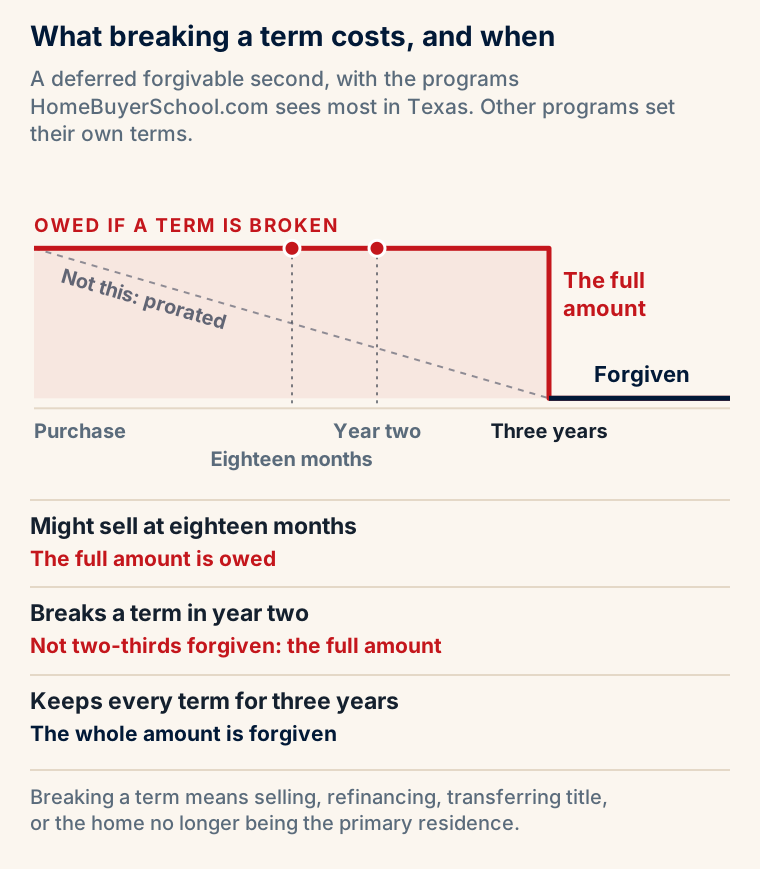
With the programs HomeBuyerSchool.com sees most in Texas, the key term is this: if the owner lives in the home as a primary residence, and does not sell, refinance or transfer title for three years after the purchase, the whole amount is forgiven. Not reduced. Forgiven.
What is the trade-off?
This is where buyers get hurt when nobody explains it. If any of those terms is broken before year three (the owner sells, refinances, transfers title, or the home stops being the primary residence), the assistance becomes repayable in full.
Not prorated, and not two-thirds forgiven for reaching year two. The full amount.
For a buyer genuinely planting roots for at least three years, that can be a very good trade. For someone who might sell in eighteen months, it is a different conversation, and one worth having before signing.
The question almost nobody asks
Not every down payment assistance program works this way. Some are deferred but never forgiven: there is no monthly payment, but the balance is still owed on a sale or refinance. Others have their own structures entirely. It depends on the program and on the buyer's situation.
So ask directly: "Which specific program am I being put into, and what are its exact forgiveness terms?"
If the person helping cannot clearly give the program name, the forgiveness timeline and what triggers repayment, that is the signal to slow down and get a better answer. It is the buyer's money and the buyer's title, and the buyer is allowed to require specifics.
| Feature | Deferred forgivable second | Deferred, never forgiven |
|---|---|---|
| Monthly payment | None | None |
| On a sale or refinance | Repayable in full if before year three | The balance is still owed |
| Forgiven | With some programs, after three years | Never |
And the honest part
This is general education, not legal or financial advice and not a commitment to lend. Assistance amounts, forgiveness terms and repayment triggers vary by program and change over time. Get the exact terms of any specific program in writing, and verify them with a licensed mortgage professional before accepting.
Comparing real offers?
The two-minute quiz narrows the list to the Texas assistance options worth a closer look for someone in this position. Then ask whoever offers one for its program name and exact forgiveness terms.