
Why an offer gets rejected, even with pre-approval
A pre-approval letter can look stronger than it is. What underwriting may check later, the documents to have ready, and what a strong letter looks like.
How does an offer fall apart after a buyer gets "pre-approved"?
A buyer gets "pre-approved" online in 20 minutes, makes an offer, and then underwriting calls with bad news. The letter was never as strong as it looked. It happens more often than it should, and it is usually avoidable.
What is the difference between pre-qualification and pre-approval?
In a competitive market, a pre-qualification letter alone can put an offer at a real disadvantage.
| Pre-qualification | Pre-approval | |
|---|---|---|
| Based on | Self-reported information | Verified documents |
| Credit check | None, or a soft pull | Usually a full credit pull |
| Typical time | 10 to 20 minutes | About 1 to 3 business days |
| Weight with sellers | Little | Much more |
What may not be checked until underwriting?
Even a solid pre-approval may not verify everything. Some details are often confirmed later, which is where surprises happen:
- Employment, beyond confirming the job exists
- Source of funds, including large deposits, gift money or borrowed down payment money
- Recent credit activity, like newly financed furniture
- The property, since appraisal issues come up later
- Exact debt-to-income math, especially for self-employment income
- Tax return details, such as write-offs that reduce qualifying income
Which documents should a buyer have ready?
Providing everything upfront makes for a stronger letter.
| Category | What to have ready |
|---|---|
| Income | About 30 days of pay stubs, two years of W-2s and federal tax returns, plus profit-and-loss statements and business returns if self-employed |
| Assets | Two to three months of statements for all accounts, retirement and investment statements, explanations for large deposits, and a gift letter if gift funds are involved |
| Debts | Current statements for cards and loans, any other mortgage statements, and any alimony or child support obligations |
| Employment | Current and recent employer contact details, and an offer letter if starting a new job |
| Other | Government-issued ID and rent payment history |
How can buyers shop rates without hurting a credit score?
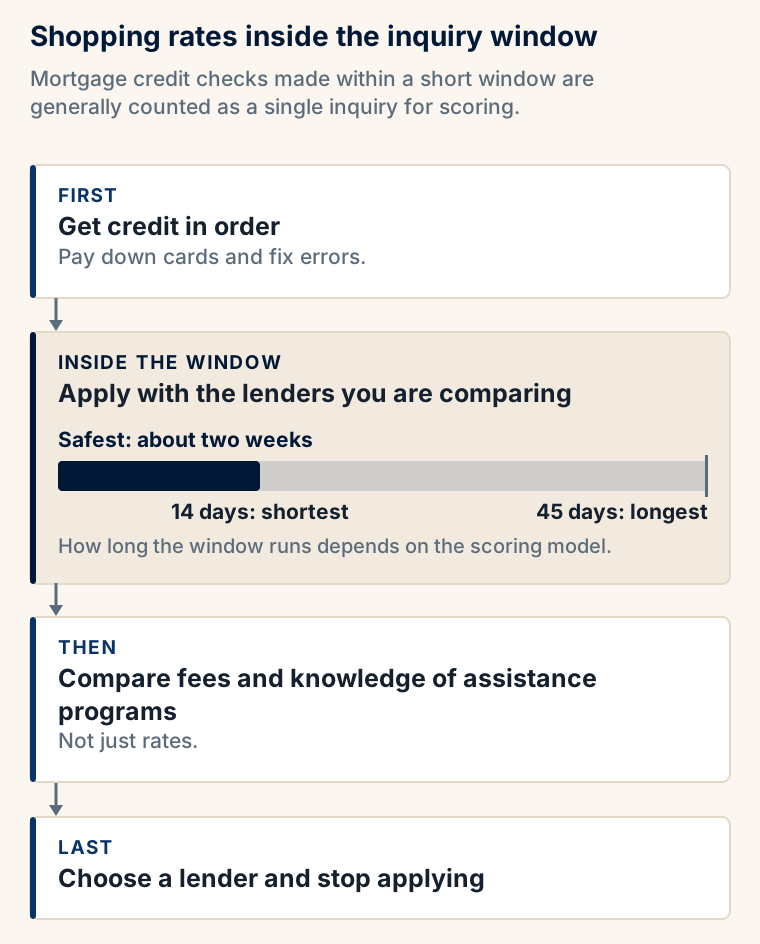
Mortgage credit checks made within a short window are generally counted as a single inquiry for scoring. Depending on the scoring model, that window can be as short as 14 days or as long as 45, so it is safest to keep rate shopping to about two weeks.
- Get credit in order first: pay down cards and fix errors.
- Apply with the lenders you are comparing within that short window.
- Compare fees and knowledge of assistance programs, not just rates.
- Choose a lender and stop applying.
What should rate shoppers avoid?
Avoid spreading applications over several months, mixing mortgage applications with car loans or new cards, or letting lenders pull credit before you are ready.
What can derail a pre-approval in underwriting?
Changes that can derail a pre-approval in underwriting include:
- Employment changes: a new job, a move from W-2 to contract work, unpaid leave or reduced hours
- New debt: financing furniture or a car, new credit cards, or co-signing
- Score drops: high card balances, any missed payment, or closing old accounts
- Deposit issues: large unexplained deposits, borrowed down payment money, untraceable transfers or cash deposits
- Property problems: a low appraisal, major inspection issues or title problems
What does a strong pre-approval look like?
A strong pre-approval usually involves documents verified upfront, ideally an underwriter's review rather than only an automated decision, a specific loan amount and rate estimate, an explanation of program options, a validity period of about 60 to 90 days, and lender contact details an agent can call.
Warning signs include a letter issued in minutes with no documents requested, vague "up to" language, or a lender unfamiliar with Texas assistance programs.
What is different about pre-approval in Texas?
Three Texas-specific things are worth keeping in mind:
- Property taxes count. Texas has no state income tax but high property taxes, and they weigh on qualification. As an illustration, taxes of $8,400 a year on a $350,000 home add $700 a month to the payment.
- Assistance programs often require approved lenders. A pre-approval from a lender that does not participate may mean missing out on down payment assistance.
- Local letters can carry weight. In multiple-offer situations, sellers often prefer a pre-approval from a lender they can reach and trust to close.
What does an action plan look like?
In order:
- Get organized: pull your credit reports, gather documents, calculate your debt-to-income ratio and check which assistance programs may apply.
- Choose lenders deliberately: compare a few in a short window, ask about Texas assistance programs, and get terms in writing.
- Provide everything upfront, and explain anything unusual before it is found.
- Keep finances steady: no job changes, new debt, big purchases or unnecessary transfers.
- Renew before it expires. Most pre-approvals last 60 to 90 days, and renewing is easier than starting over.
And the honest part
This is general education, not a commitment to lend or an offer of credit. What a pre-approval covers, which documents are needed, how credit inquiries are scored and how long a letter stays valid all vary by lender, loan program and scoring model. Ask your lender exactly what they have verified.
Want a pre-approval that holds up?
Start with the two-minute quiz. It narrows the list to the Texas programs and options worth a closer look for someone in this position, before the documents go to a lender.