
The score you think you have vs. the score a lender pulls
Many credit apps show a VantageScore. Mortgage lenders typically pull FICO 2, 4 and 5 and use the middle one. Why the gap matters and how to see the real scores.
Why doesn't the score in a credit app match the one a lender pulls?
The score in a credit app and the score a mortgage lender pulls are two different numbers, from different scoring models. The gap commonly runs 40 or 50 points in either direction, and it is not a rounding error.
Some buyers walk into a lender thinking they are a 680 and find out they are a 631. Others assume the door is closed, never check, and learn a year later that their mortgage scores were fine all along. That is twelve months of rent paid on a guess. The guess is the problem, not the number.
Why do the numbers differ?
Credit apps like Credit Karma show a VantageScore. Mortgage underwriting has long used older FICO models. Nobody is hiding anything: it is two systems measuring the same credit file and arriving at different numbers.
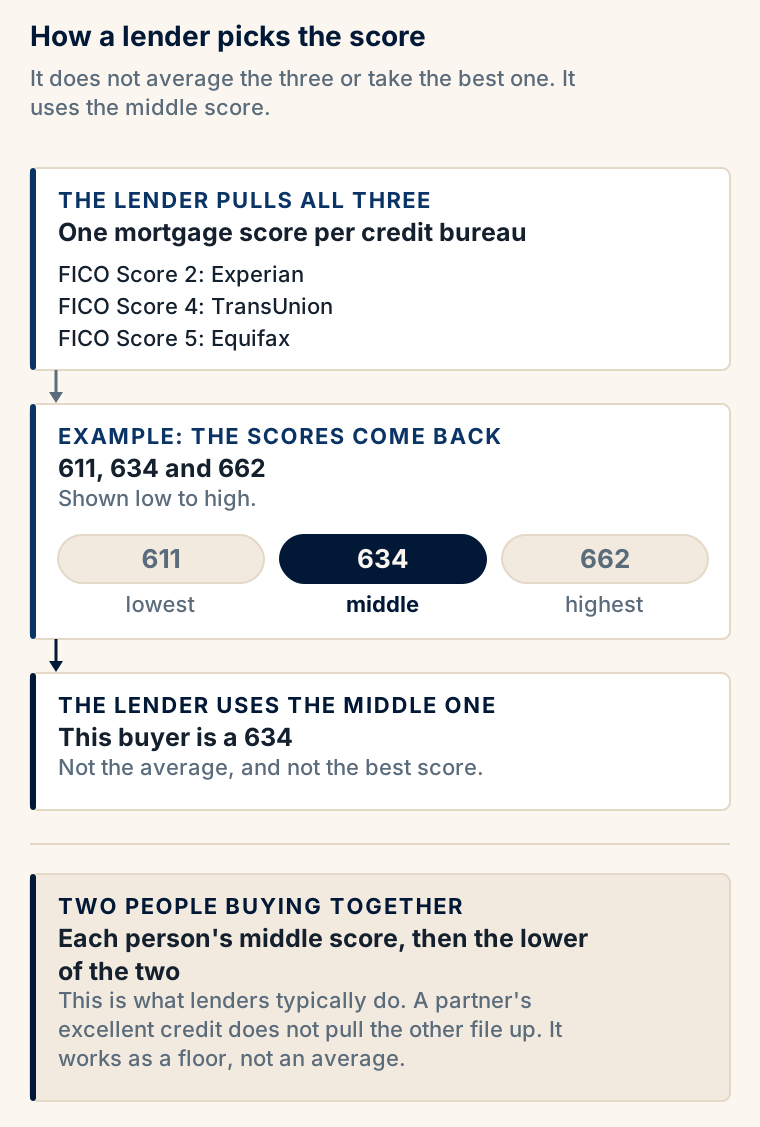
The mortgage versions are called FICO 2, 4 and 5, one per credit bureau:
- FICO Score 2: Experian
- FICO Score 4: TransUnion
- FICO Score 5: Equifax
Which score does the lender use?
The lender pulls all three. It does not average them or take the best one. It uses the middle score. A buyer whose scores come back at 611, 634 and 662 is a 634.
When two people buy together, it goes one step further. The lender typically takes each person's middle score and then uses the lower of the two. A partner's excellent credit does not pull the other file up. It works as a floor, not an average.
Why 40 points is money, not trivia
Loan pricing moves in tiers, not on a smooth curve, and many assistance programs have hard score cutoffs. In Texas, 620 and 640 are the two buyers run into most often. A 631 and a 671 can mean different loan products, different prices and a different set of programs worth asking about, for the same person with the same income.
How can a buyer see the real scores without applying?
The mortgage scores can be pulled directly at myFICO.com, without applying for anything or talking to a loan officer. HomeBuyerSchool.com is not paid to recommend myFICO.
A few practical notes:
- It may be a subscription rather than a one-time purchase. Set a reminder to cancel once you have what you need.
- Checking your own credit is a soft inquiry. It does not affect the score.
- Check the current price before buying. It was about $30 when this was written in September, and pricing changes.
Then what?
The useful question is which side of the nearest cutoff the score landed on, and how far away it is. Eleven points below 620 is often a short stretch of targeted work. Sixty points below is a real plan with a real timeline. Both can be workable; they are just different projects, and the guide on how to raise a credit score before buying a house covers the work itself.
The worst version is finding out on the day of trying to buy a house, with no time left to do anything about it. Pulling the scores early, when nothing is riding on it, gives a buyer the truth on their own schedule.
And the honest part
This is general education, not a commitment to lend or an offer of credit. Score cutoffs, programs, pricing and the scoring models lenders use can change and vary by lender and by loan. Verify the details with a licensed mortgage professional before relying on them.
Already pulled your scores?
Bring the middle score to the two-minute quiz. It narrows the list to the options worth a closer look for someone in this position.