
The "starter home" strategy may be costing buyers about $400 a month
In a March 2026 illustration, a new build with a builder rate came to about $373 a month less than a 10-year-old resale at the same price.
Is the oldest house you can find still the cheapest way in?
The classic first-time buyer advice goes like this: start small, buy the oldest house you can find, fix it up later. That made sense when new construction carried a premium. When builders are sitting on inventory and paying to lower buyers' interest rates, a brand-new home can cost less each month than a 10-year-old resale at the same price.
Can the same price mean a different monthly payment?
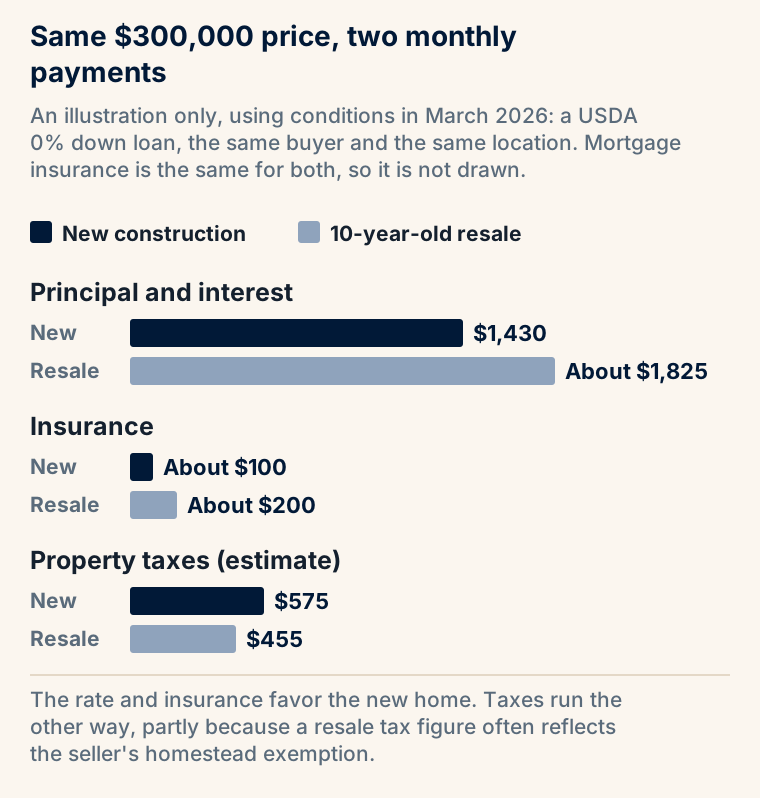
An illustration only, using conditions in March 2026: a $300,000 home with a USDA 0% down loan, the same buyer and the same location. Builder promotions, rates, taxes and insurance will be different.
| New construction | 10-year-old resale | |
|---|---|---|
| Interest rate | 3.99% builder promotional rate | 6.125% market rate |
| Principal and interest | $1,430 | $1,825 |
| Insurance | About $100 | About $200 |
| Property taxes (estimate) | $575 | $455 |
| Mortgage insurance | Same for both | Same for both |
| Total monthly payment | About $2,194 | About $2,567 |
Why do the resale taxes look lower?
The resale tax figure often reflects the seller's homestead exemption, which lowers school taxes. That exemption does not transfer to the buyer, who has to file their own. The builder's estimate for the new home assumes no exemption yet. Once the new owner's exemption is in place, the tax bills on the two homes may end up closer than they look on paper, while the gap from the interest rate and insurance can remain.
What does the monthly payment leave out?
Three costs sit outside the payment comparison:
- Repairs. New construction typically comes with a one- to two-year workmanship warranty and a 10-year structural warranty. With a resale, repairs are the owner's from day one, and an HVAC system, roof or water heater can cost thousands.
- Utilities. Older homes often have less efficient insulation, windows and HVAC, which can mean higher monthly bills.
- First-year updates. Even a move-in-ready resale often gets thousands of dollars of paint, flooring or fixtures in the first year.
Does that change the gap?
Counting those, the real gap in cost of ownership can be wider than the payment difference alone.
Why do builders do this?
When builders have completed homes they need to sell, they may buy down rates below market, cover closing costs, add upgrades, and lean on warranties. These conditions come and go with the market, and the terms vary by builder and community.
What should buyers ask before assuming older is cheaper?
Four questions are worth answering first:
- Have I compared the full monthly payment on new construction and resale after builder incentives?
- Is the builder's rate permanent, or a temporary buydown that rises later?
- Am I counting repairs, insurance and utilities on the older home?
- How much will I spend updating a resale in the first two years?
So which one is the budget option?
For some buyers, new construction will be the budget option. For others, a resale in the right location will still make more sense. Running the numbers both ways is the only way to know.
And the honest part
The payments above are an illustration from March 2026, not a quote or forecast. Builder incentives, rates, taxes, insurance, warranties and USDA eligibility vary by builder, property, location and buyer, and change over time. This is general education, not a commitment to lend. Run the numbers for any specific home with a licensed mortgage professional.
Which programs are worth a closer look first?
The two-minute quiz narrows the list to the options worth a closer look for a buyer in this position.