
How builder payment ads work, and how to find the real payment
Why a $395,000 new home advertised at $1,390 a month can cost far more, and how to add up taxes, insurance, mortgage insurance and HOA dues.
Is the payment in a builder ad the real payment?
A $395,000 home advertised at "$1,390 a month" sounds close to rent for a lot of people. For most first-time buyers, the real payment on a home like that is far higher. Here is how the advertised number is built, and how to work out the real one.
What makes an advertised payment look low?
Five things make an advertised payment look low.
- A large down payment. The fine print often assumes 20% down, which is $79,000 on a $395,000 home. Many first-time buyers put down 0% to 5%, so they finance much more.
- No property taxes, or a low estimate. Texas property taxes often run about 1.5% to 3.1% of the home's value a year, depending on the school district, county and any special district such as a PID or MUD. On a $395,000 home, that can be roughly $500 a month or more.
- No homeowner's insurance. For new construction in Texas, insurance often runs about $100 to $200 a month, and more in flood or high-wind areas.
- No mortgage insurance. With less than 20% down, mortgage insurance typically costs about 0.5% to 1% of the loan a year, which on a $375,000 loan is roughly $160 to $310 a month.
- A temporary rate. Many ads use the first-year rate from a temporary buydown, such as a 3-2-1, where the rate rises each year until it reaches the permanent rate.
What does the real payment look like, worked through?
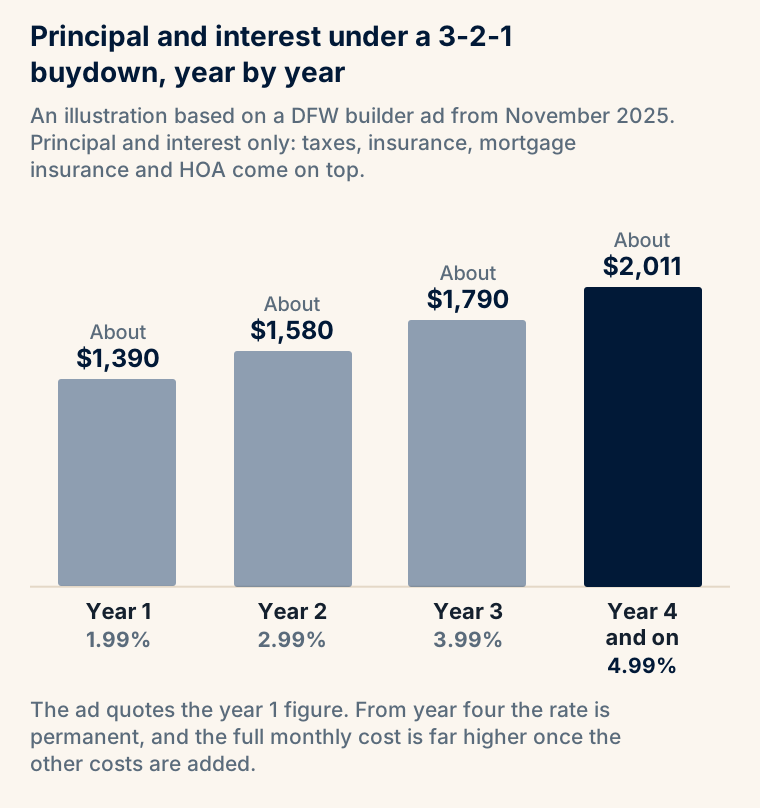
An illustration based on a DFW builder ad from November 2025: a $395,000 home with 5% down, a 3-2-1 buydown from 1.99% to a permanent 4.99%, and an HOA.
| Year | Rate | Principal and interest |
|---|---|---|
| 1 | 1.99% | About $1,390 |
| 2 | 2.99% | About $1,580 |
| 3 | 3.99% | About $1,790 |
| 4 and on | 4.99% | About $2,011 |
What is the full monthly cost from year four?
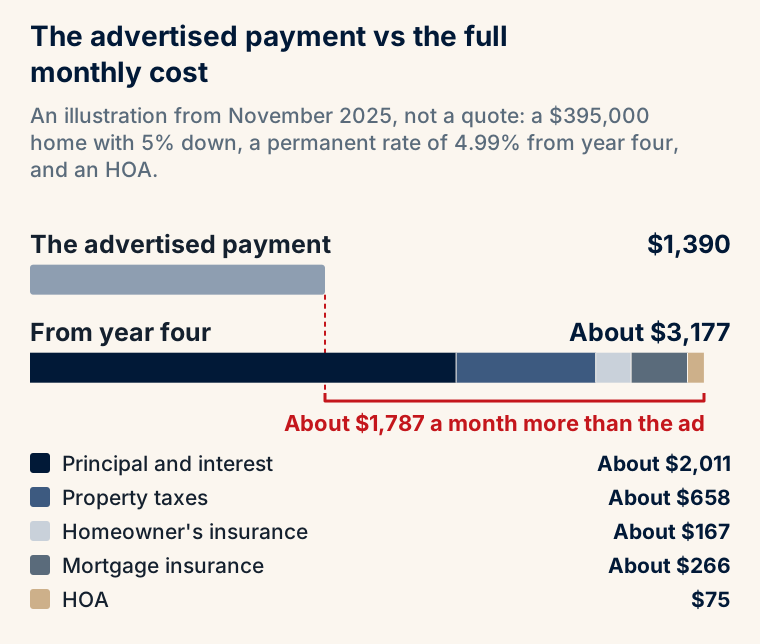
From year four, the full monthly cost looks like this:
| Cost | Monthly |
|---|---|
| Principal and interest (4.99% on $375,250) | About $2,011 |
| Property taxes (2% of $395,000) | About $658 |
| Homeowner's insurance | About $167 |
| Mortgage insurance (0.85% a year) | About $266 |
| HOA | $75 |
| Total | About $3,177 |
Why do the ads look this way?
The assumptions behind the advertised number are usually disclosed in the fine print: "based on 20% down," "first-year rate only," "taxes and insurance not included." But the big number in the headline is what sticks, and by the time a buyer sees the full payment, they may already be attached to the house.
What else should a buyer watch for?
A few other things are worth watching for:
- "We'll pay your closing costs." Some builders genuinely help with closing costs. It is still worth checking whether the price went up recently and reading the contract, because a higher price can mean paying for those costs over 30 years.
- Lot premiums. Corner, cul-de-sac or view lots can add $10,000 to $20,000 or more.
- Model-home upgrades. The model usually shows upgraded flooring, countertops, appliances and fixtures. Getting that look can add tens of thousands of dollars to the base price advertised online.
How do you calculate the real payment?
Add up these five costs. That total is the real monthly cost of owning the home.
- Principal and interest. Start with the price, subtract your actual down payment, and add any upfront mortgage insurance or funding fee on a government loan. Use the permanent rate, not the teaser rate.
- Property taxes. Look up the total tax rate for the address, multiply by the price and divide by 12. Check whether the subdivision has a PID or MUD, which can add a significant amount each month.
- Insurance. Get a real quote from an insurance agent.
- Mortgage insurance, if putting down less than 20%. About 0.5% to 1% of the loan a year, divided by 12.
- HOA dues, if the neighborhood has them.
What should a buyer ask at the model home?
These are the questions to ask at the model home:
- "What is the total property tax rate here, including any PID or MUD, and what would my yearly taxes be?"
- "What does the base price include, and what in this model is not included?"
- "With my down payment at today's permanent rate, including taxes, insurance and mortgage insurance, what is my total monthly payment?"
- "Can you give me that in writing?"
Can new construction still be a great option?
None of this means new construction is a bad deal. Many builders are transparent, some offers are genuinely good, and new homes come with warranties and modern features. For many first-time buyers, new construction is the most affordable option. The goal is simply to compare real numbers, not advertised ones.
And the honest part
The payment above is an illustration from November 2025, not a quote. Rates, buydown terms, taxes, insurance, mortgage insurance and HOA dues vary by builder, property, location and buyer, and change over time. This is general education, not a commitment to lend. Get a written estimate for any specific home.
Want help decoding a builder's numbers?
The two-minute quiz narrows the list to the options worth a closer look for someone in this position.